Key takeaways
• Commercial property campaigns have traditionally measured demand after launch. First-party buyer data now shows it before a campaign goes live.
• Ready Media Group’s CommercialReady and DevelopmentReady platforms have built a first-party database of more than 145,000 unique buyers, offering insight into the asset classes, price points and regions developers and investors are pursuing.
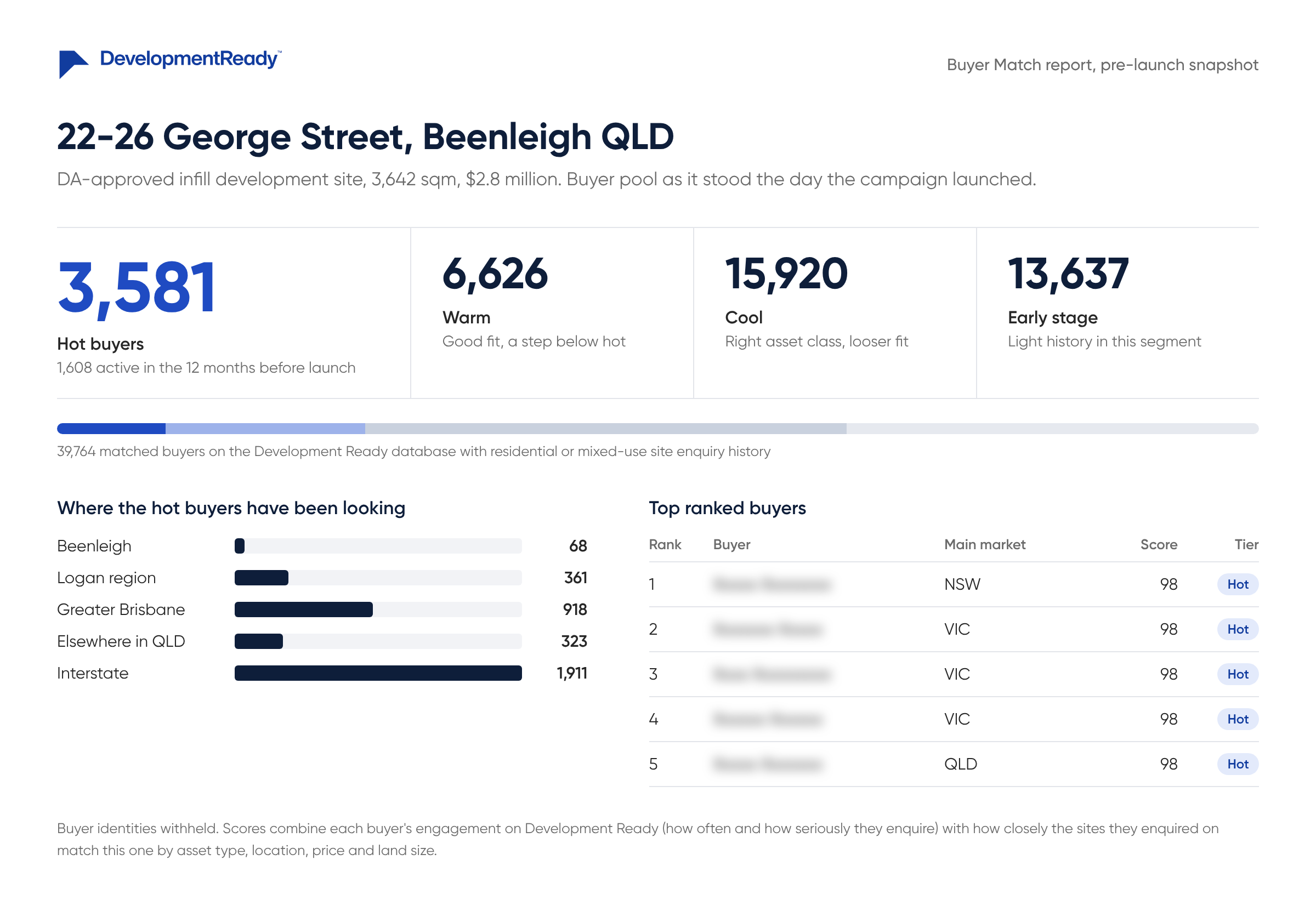
• Buyer Match grades buyers as hot, warm, cool or early stage. In one strong-match example, a DA-approved infill site in Beenleigh, Queensland, matched 39,764 buyers before launch, including 3,581 hot buyers.
• The Audience Calculator models social reach from first-party data. An industrial campaign in Brisbane currently models an addressable audience of around 330,000.
• Agents get stronger tender pitches. Vendors see evidence of demand before committing spend. Ask any commercial agent how a campaign will perform and the honest answer has usually been: we’ll know in a few weeks.
The listing goes live, the ads run, the enquiries arrive or they don’t, and only then does the real picture of demand emerge.
Vendors feel this most acutely. They are asked to commit marketing budget, agree on a method of sale and set price expectations on the strength of an agent’s experience and comparable sales. Experience matters, but it is still an educated guess about who is out there and how motivated they are.
That guess is becoming harder to justify. The tools now exist to see buyer appetite at the start of a campaign, not the end.
From list and wait to know your buyers first The conventional portal model has served the industry well. A property is listed, buyers who areactively searching find it, and the agent receives a report of views and enquiries. It is a reliable destination, and for many assets it remains an essential part of the mix.
Its limitation is timing. A listing destination can only tell you about demand once the campaign is underway. It reflects who happened to search during the campaign window, not the wider pool of capable buyers who might act on the right opportunity. By the time the data arrives, the budget is committed and the strategy is set.
For commercial and development property, where the buyer pool is smaller, more specialised andoften not actively searching, that gap matters.
What’s changed: the buyer pool is now visible
Over several years, Ready Media Group’s CommercialReady (CR) and DevelopmentReady (DR) platforms have built a deep first-party database of active developers and investors. These are buyers who have registered, enquired, accessed data rooms and engaged with opportunities across the country. The database now holds more than 145,000 unique buyers.
Because that data is first-party, it captures behaviour, not just contact details: the asset classes abuyer pursues, the price points they engage with, the regions they watch and how recently they have acted. That turns a database into something more useful — a live map of demand that can be read before a property goes to market.
Reading demand before launch
Consider an agent preparing for a tender on a 4,000 square metre development site in a growth corridor. Three agencies are pitching. Each will present comparable sales, a marketing schedule and a fee. Traditionally, the agent’s confidence about buyer interest would rest on their own contacts and past results. Now the agent can request a Buyer Match report. It identifies the buyers already on the CR and DR database whose behaviour aligns with this specific opportunity, and grades them as hot, warm, cool or early stage based on how closely and how recently they have engaged with similar sites. The agent walks into the pitch able to say how many qualified buyers are already in play, what kind of buyers they are, and where they are concentrated.
That is a different conversation with a vendor. It moves the discussion from “we think there’s strong interest in this type of site” to “here is the interest, and here is who it comes from”.
One recent example shows what a strong match can look like. Before the campaign for a DA-approved infill development site in Beenleigh, Queensland, went live, the report identified 39,764 buyers on the DevelopmentReady database with relevant site enquiry history. Of those, 3,581 were graded hot, and 1,608 of them had been active in the previous 12 months. More than half of the hot buyers (1,911) had mostly been looking at sites interstate. That is demand an agent would struggle to see through local contacts alone.
Beyond the people already searching
Knowing the buyers on hand is half the picture. The other half is reach: how many relevant people can a campaign realistically put the opportunity in front of, including those who are not browsing portals that week?
RMG’s Audience Calculator answers that question. It takes the first-party buyer data and models how far it can be extended through social channels, using the profiles of known developers and investors to find similar audiences. The result is a credible estimate of the reach available to a specific property, grounded in real buyer data rather than broad demographic targeting. For example, an industrial campaign in Brisbane currently models an addressable audience of around 330,000 people across 10 industrial subtypes.
For the agent in our tender, that completes the pitch. Buyer Match shows who is already interested. The Audience Calculator shows how the campaign will find the rest. What it means for agents and vendors For agents, evidence wins listings. Arriving at a tender with a view of matched buyers and a modelled reach plan sets a pitch apart from one built on comparables alone. It also makes it easier to set realistic vendor expectations early, because the conversation about price and method of sale starts from data.
For vendors, the benefit is confidence before commitment. They can see the depth of buyer interest and the reach a campaign is likely to achieve before they approve spend. If demand for a particular asset is thinner than hoped, that is better known at the start than discovered three weeks in.
“The industry has always measured campaigns after they finish. We think the more valuable question is what the market looks like before you begin. Our buyer data now lets agents and vendors answer that question with evidence, and plan the campaign around real demand rather than assumption.”
— Jake Ragkousis, National Sales Director, Ready Media Group.
The campaign starts earlier now
Listing destinations will remain part of how commercial and development property is sold. What is changing is when the important work happens. The agents who win the next cycle of listings will be those who can show demand before launch, not just report it afterwards. Agents can request a Buyer Match report or an Audience Calculator estimate for their next opportunity through their Ready Media Group account director.